

How Long Does a First Aid Course Take in Australia?
A standard First Aid course can be completed in one day. Our HLTAID011 First Aid course takes six hours plus breaks, includes CPR and has no online homework.
To work out how long a First Aid course takes in total, add any preparation to the classroom hours. Then allow for assessment and certificate processing, especially when you need proof of training for a job or placement.
In Short
- Our First Aid course takes six hours plus breaks and includes CPR.
- Our CPR-only course takes 2.5 hours plus breaks.
- Our Childcare First Aid course takes 6.5 hours plus breaks.
- Certificate issue depends on passing the assessments and completing the enrolment checks.
How long does a First Aid course take?
The course you choose is the first thing that affects the time needed. CPR-only training covers fewer skills than a full First Aid course. Childcare First Aid adds content relevant to emergencies in education and care settings.
The following times are for our face-to-face courses at National Courses. All three include practical assessment and require no online pre-work.
| Course | Main unit | Who it suits | Our course duration |
| CPR | HLTAID009 | People who need CPR training or a CPR refresher. | 2.5 hours plus breaks. |
| First Aid, including CPR | HLTAID011 | People who need a broad First Aid response for work, study or everyday situations. | 6 hours plus breaks. |
| Childcare First Aid | HLTAID012 | People who need First Aid training for an education or care setting. | 6.5 hours plus breaks. |
Check the unit code requested by your employer or placement organiser before choosing the shortest option. A CPR certificate does not cover all the skills in HLTAID011. Likewise, a role that requests HLTAID012 needs the education and care unit, rather than a course selected only by its length.
People attending our First Aid course including CPR do not need to book a separate CPR class for the same training day.
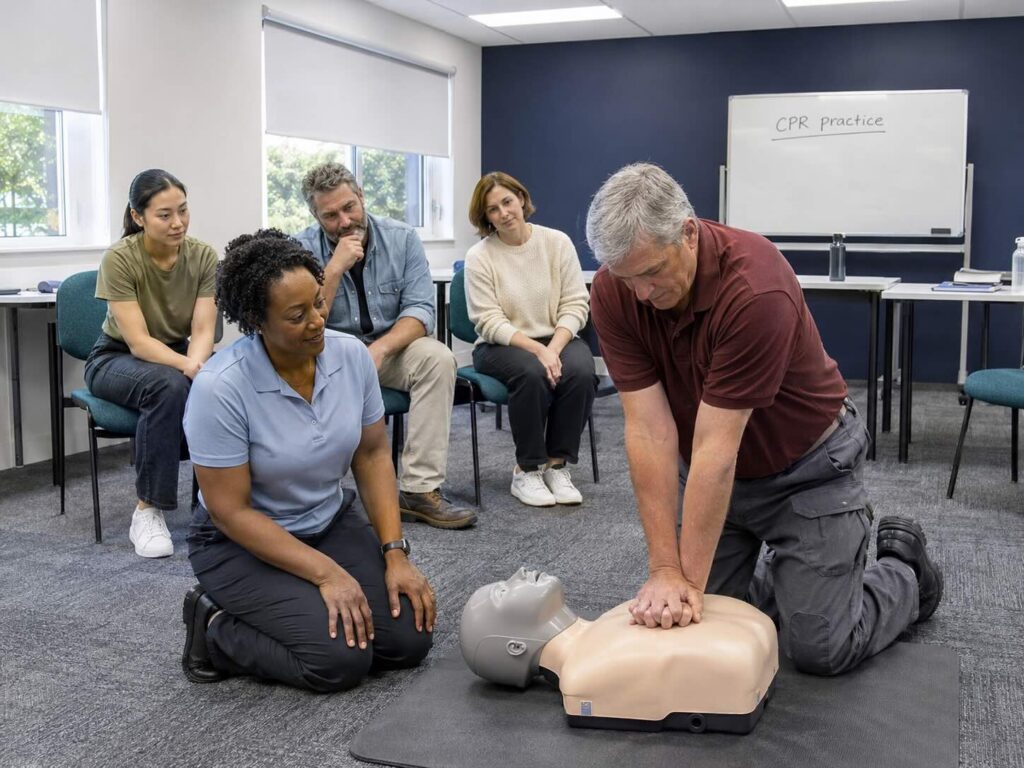
How does the course format affect the total time?
Two providers can offer the same national unit with different classroom hours. One may teach everything during the session, while another asks you to complete theory at home first.
Compare the total learning and assessment time before deciding which course fits your schedule.
Face-to-face First Aid training
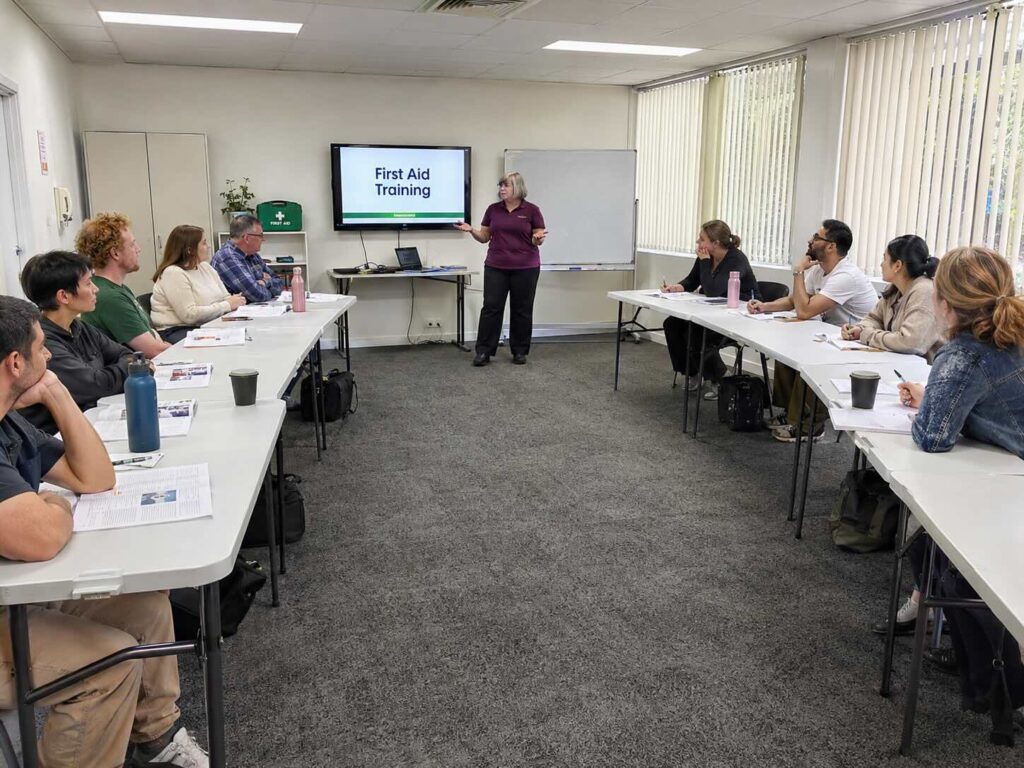
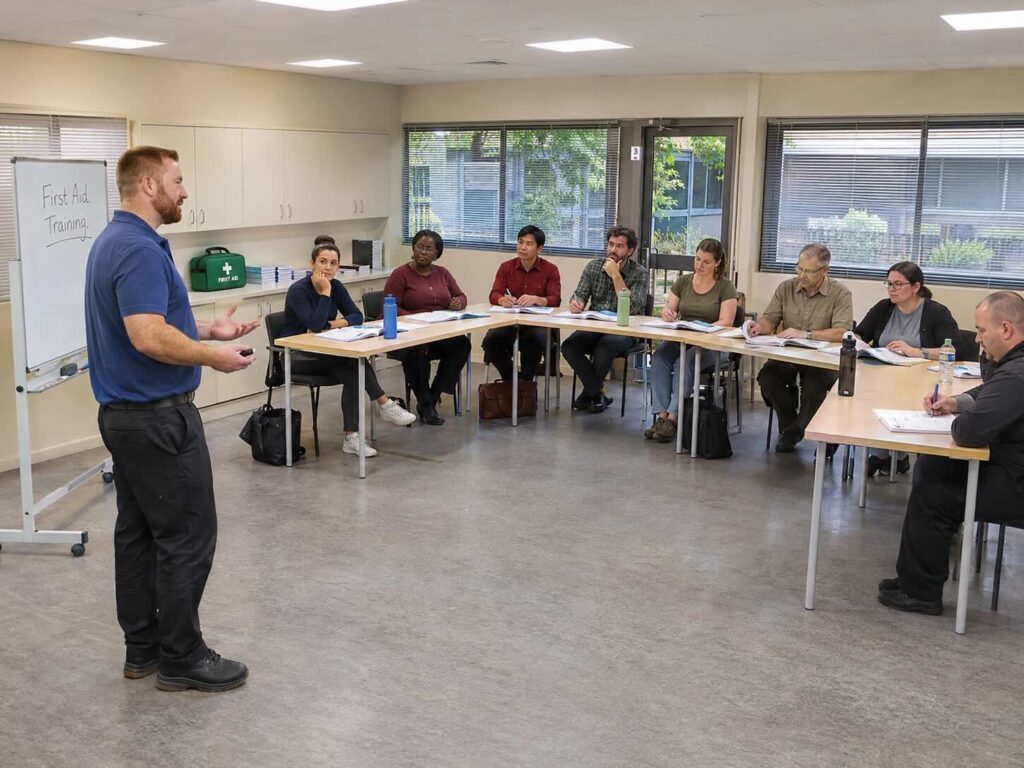
In a classroom course, a trainer explains the content, demonstrates techniques and guides your practice. You ask questions as you go and complete the required assessments during the scheduled session.
Our courses use this format without online homework. Across the wider market, some courses described as face-to-face still include preparation, so read the booking details carefully.
Check the start and finish times as well as the stated learning hours. Breaks and registration can affect the total time you need away from work or other commitments.
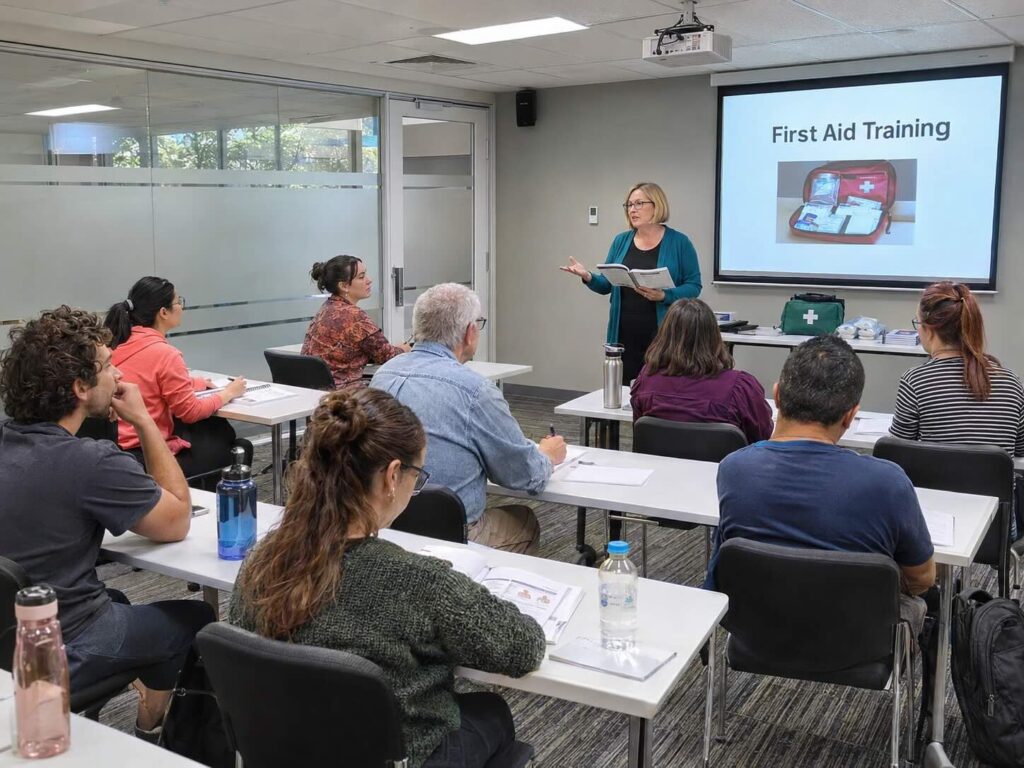
Online theory followed by practical training
A blended course divides the learning between online study and a practical session. The online component may include reading, videos, activities and knowledge questions. You then attend to practise and demonstrate the required skills.
A shorter classroom booking does not necessarily mean less work overall. For example, three hours of online study followed by a three-hour practical session still adds up to six hours. This is a planning example; the actual split depends on the provider.
Online study time also varies with your reading speed and familiarity with the content. Complete any required work before the provider’s deadline. Arriving with unfinished theory can prevent you from completing assessment that day.

Can you complete First Aid entirely online?
You cannot get your HLTAID011 certificate by completing online reading and quizzes alone. The national unit requires practical evidence, including CPR on manikins and responses to simulated emergencies.
Some providers deliver theory online, but they still need to assess the required physical skills using suitable equipment. Our courses require face-to-face attendance for training and assessment.
When comparing an online offer, check exactly how the practical component is delivered, who assesses it and which unit appears on the final Statement of Attainment.
What happens during a First Aid course?
The day combines explanations, demonstrations, practice and assessment. You spend time working with equipment and responding to scenarios, rather than only listening to a presentation.
CPR and using a defibrillator
Cardiopulmonary resuscitation, or CPR, uses chest compressions and rescue breaths to help a person in cardiac arrest. You practise on adult and infant manikins so the trainer can observe your technique, alongside the steps for recognising and responding to an emergency.
You also use an automated external defibrillator, or AED, training device. This lets you practise following the device’s prompts and working through the response safely.
Our CPR course focuses on these skills. The full First Aid course continues into a wider range of injuries and medical emergencies.
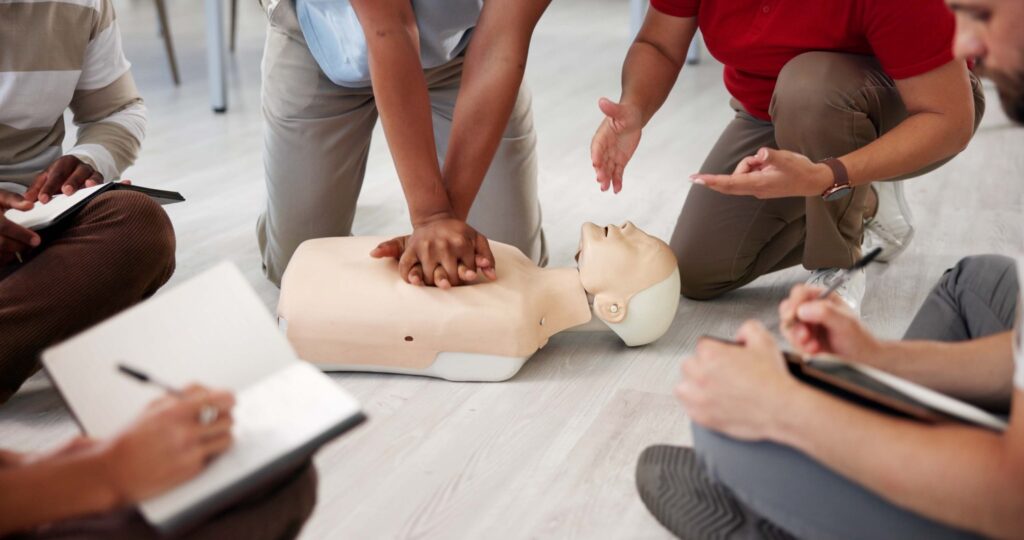
Responding to injuries and medical emergencies
First Aid training covers situations such as bleeding, burns, choking, fractures, asthma and anaphylaxis. You learn to recognise the problem, provide an appropriate response and monitor the casualty until further help is available.
Activities may involve dressings, bandages, an adrenaline auto-injector training device and an asthma inhaler training device with a spacer. The trainer explains the equipment before you practise with it.
Practising realistic scenarios
Scenarios bring several skills together. You may need to assess the scene, identify the casualty’s needs, select equipment and explain what has happened to emergency services.
There is also time for reporting and reviewing the response. This helps you connect individual techniques with the decisions you would need to make during an emergency.
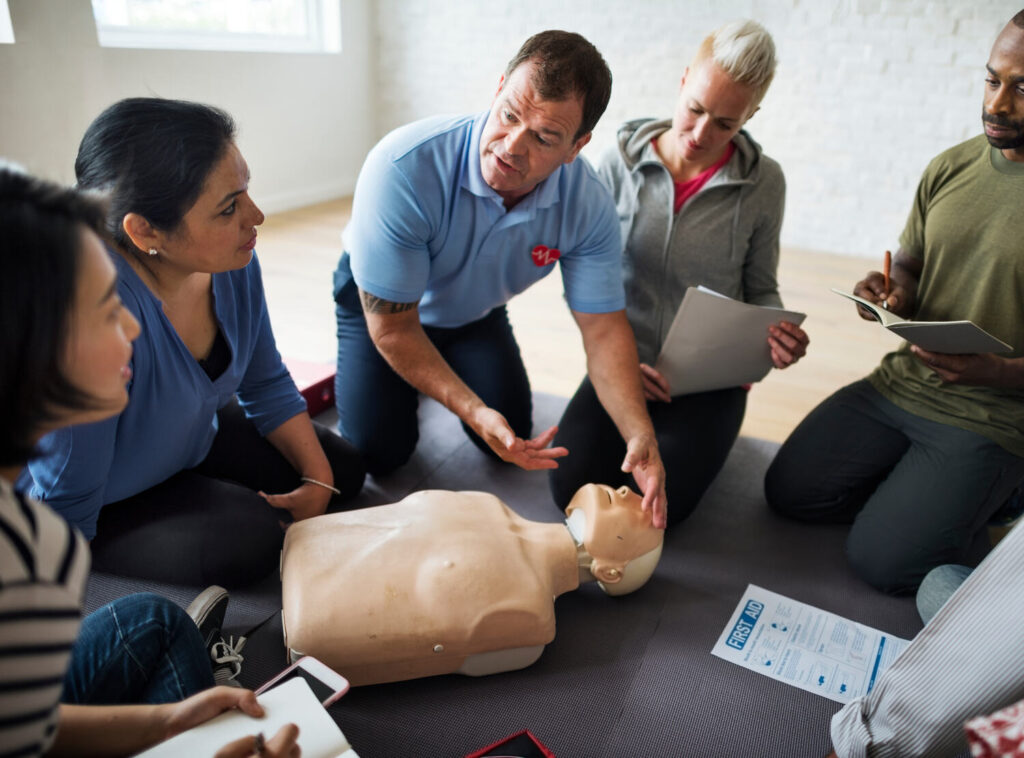
How long does the First Aid assessment take?
There is no separate national assessment time that applies to every First Aid class. Assessment can be spread through the session, with knowledge questions, observed skills and scenarios completed at different stages.
The trainer must collect evidence of your own performance. Watching someone else complete a task or joining a group discussion does not replace the practical demonstrations you need to complete yourself.
The HLTAID011 assessment requirements include at least two minutes of uninterrupted CPR on an adult manikin on the floor and at least two minutes on an infant manikin on a firm surface. These are individual tasks within a broader assessment, not the total assessment duration.
Allow time to practise before assessment and respond to feedback. A technique that needs improvement may require another demonstration. The provider’s reassessment arrangements determine the next step if you cannot complete a requirement during the booked session.
What should you organise before attending?
Prepare for the practical session as well as the paperwork. The following steps make it easier to complete the course within your booked time.
- Confirm the required unit code with your employer, education provider or placement organiser.
- Read the enrolment confirmation and complete any preparation required by your provider.
- Bring the accepted identification and have your USI ready.
- Wear comfortable clothing that allows you to kneel and move during practical activities.
- Discuss any physical, language or learning support needs before the session.
- Check the arrival time, venue address and expected finish time before arranging transport.
Your Unique Student Identifier, or USI, connects your nationally recognised training records. You can create or find your USI before the course. Use personal details that match your identity documents.
For our First Aid course, bring current original photo ID. You need enough English to follow instructions, answer questions and communicate during practical activities.
Tell the provider about support needs before paying for a course. Some adjustments may be possible, but they cannot remove a required practical skill or change the standard you need to demonstrate.
How soon will you receive your First Aid certificate?
Your certificate is a Statement of Attainment. It records the nationally recognised units you have successfully completed and is issued by the training provider after the required checks.
We issue our First Aid certificate on the same day after successful assessment and verification of your identity and USI. Our course includes HLTAID011, HLTAID009 and HLTAID010.
Across providers, issue times can differ. Missing identity documents, an unverified USI or an outstanding assessment can delay the certificate even after you have attended the class.
Book before the date your employer needs the document. Finishing a session on the morning of a certificate deadline leaves little room to resolve a problem. For jobs that request First Aid certification, completing training before applying also gives you clear evidence to include with your application.

How long does First Aid refresher training take?
CPR refresher training takes about three hours in total, including breaks. The duration is the same as our regular CPR course.
During the session, you’ll revisit key CPR skills, practise your technique and complete the required assessments. Even if you’ve completed CPR training before, you’ll need to attend the full session. This gives you time to refresh your knowledge and build confidence in your practical skills.
Book your First Aid course with National Courses
We are a Registered Training Organisation, RTO 41072. Our face-to-face courses give you time to practise with a trainer and complete your assessment during the session.
Find your First Aid course to view dates and locations. For an education or care role, check our Childcare First Aid training against the unit your workplace requires.
Find your First Aid course with National Courses
Ready to take the next step? Explore our short courses, choose your training location and check upcoming dates with our team.
National Courses Pty Ltd · RTO 41072.
Need a hand choosing? Call 1300 677 191.

Samuel Bohr


Elevated Work Platform (EWP) Ticket: Complete Guide
March 25, 2025Why Choose National Courses for Your Accredited Training
November 6, 2025